Waterfront properties have long captured the imagination of homeowners and investors alike.
Whether perched beside a serene lake or overlooking tidal estuaries, these homes promise tranquillity, privacy and stunning views. Yet, behind their allure lies a complex environmental challenge: the ever-present threat of flooding and the growing unpredictability of weather conditions. As climate change reshapes coastlines and riverbanks, even the most lavish developments are not immune. Within this context, luxury waterfront homes demand both innovation and foresight.
Understanding The Growing Flood Risk
Flooding has become an increasing concern in the UK, particularly for properties situated near rivers, lakes and coastal areas. Environment Agency data shows that one in six homes in England is at risk of flooding, a figure that continues to rise with changing rainfall patterns and rising sea levels.
For luxury waterfront developments, these environmental realities are part of the design conversation from the beginning — influencing everything from site selection to long-term maintenance strategies.
Developers are now under pressure to balance aesthetics with practicality, ensuring that each project remains desirable while still protecting residents and ecosystems. In many cases, the environmental risks faced by these homes can be mitigated through careful planning rather than avoided entirely.
Smart Design And Sustainable Engineering
Modern architecture is redefining what it means to live near water. Instead of retreating from the shoreline, designers are embracing its challenges with smarter, eco-conscious solutions. Elevated structures on reinforced foundations, permeable landscaping that absorbs excess surface water, and raised utilities are becoming standard practice in high-end construction.
Some luxury waterfront homes integrate natural features into their flood-defence strategies — using reed beds, wetlands and floodable gardens to manage runoff while enhancing biodiversity. These sustainable systems not only protect against inundation but also create habitats that benefit local wildlife, blending resilience with environmental responsibility.
The Climate Factor And Long-Term Resilience
Climate change adds another layer of complexity to the equation. According to the UK Climate Projections (UKCP18), average sea levels could rise by as much as a metre by 2100 in some regions, while heavier rainfall events continue to test drainage systems inland. For premium properties along rivers and coastlines, this means that resilience must extend beyond the present moment.
Developers and homeowners are now working closely with environmental consultants to future-proof their assets. This involves assessing flood modelling data, investing in adaptive infrastructure, and choosing building materials that can withstand moisture and erosion. It’s a fundamental shift from risk avoidance to intelligent adaptation — a philosophy that’s increasingly central to sustainable luxury.
Insurance, Maintenance, And Market Perception
While insurance remains a major consideration, many insurers are now factoring resilience measures into their premiums. Homes equipped with flood barriers, water-resistant finishes and reliable runoff systems can often access more favourable terms. This reflects a growing recognition within the financial sector that not all waterfront properties share the same level of vulnerability.
Interestingly, despite recurring news about severe floods, the market for luxury waterfront homes remains robust. Buyers are still drawn to the serenity, prestige and lifestyle benefits — particularly when developments demonstrate responsible environmental management. A well-designed flood mitigation strategy can enhance rather than diminish a property’s appeal, turning an apparent risk into a mark of quality and confidence.
The Environmental Responsibility Of Developers
For developers and investors, building responsibly on the waterfront carries a moral as well as commercial dimension. Adopting low-impact construction methods, protecting natural buffers like mangroves or river meadows, and avoiding over-development are all essential steps. Collaborations between developers, local councils and conservation bodies can ensure that projects respect local ecosystems while still providing desirable living spaces.
Moreover, eco-driven architecture — such as passive heating systems, solar integration and green roofing — can further reduce a development’s carbon footprint. This alignment of luxury and sustainability is shaping the future of modern British housing, proving that opulence and ecological awareness need not be mutually exclusive.
So, Are Luxury Waterfront Homes Always At Risk?
The short answer is yes — to some extent. Flooding will always be a factor where water and property meet. However, the level of risk depends largely on location, elevation, planning and design. Today’s luxury waterfront homes are not defined solely by their views but by their capacity to adapt to changing environmental conditions. Through sustainable innovation, resilient engineering and smarter policy frameworks, homeowners can continue to enjoy life beside the water without living in fear of it.
By acknowledging that risk and beauty coexist, the property industry is moving toward a more balanced future — one where human comfort and environmental respect flow together as naturally as the rivers themselves.
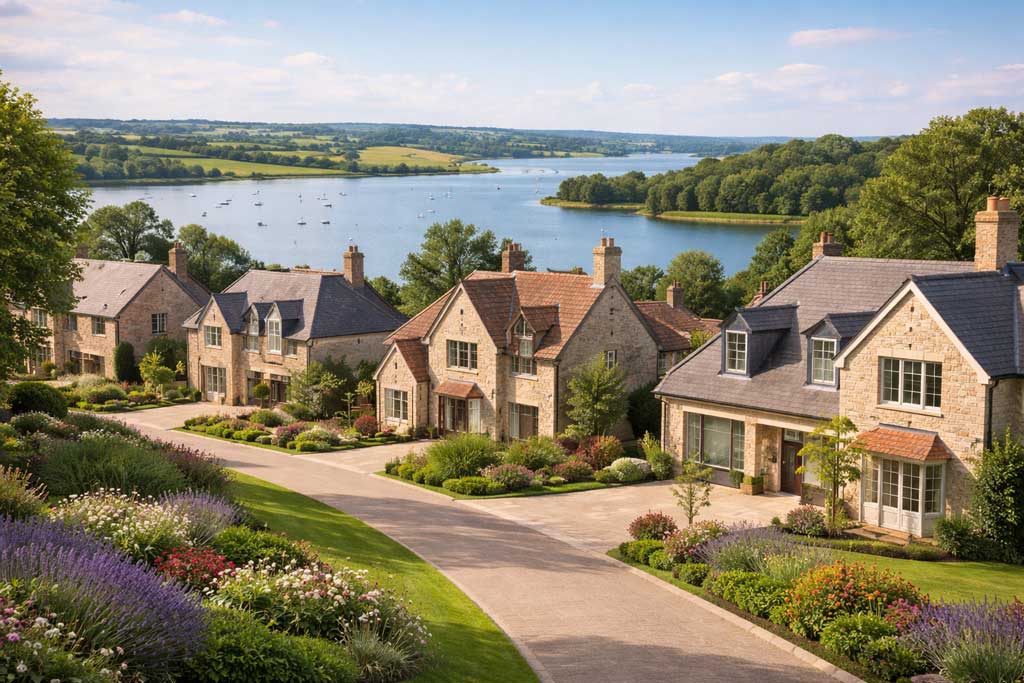
Featured image credit: AI generated.